Zhixin Lu Scientist, Allen Institute

Building intelligent
dynamical systems.

How do evolving systems remember, infer, generate, and learn?

I connect dynamics for AI with AI for dynamics to understand and build intelligence. Physical AI and learning are central interests in this program.

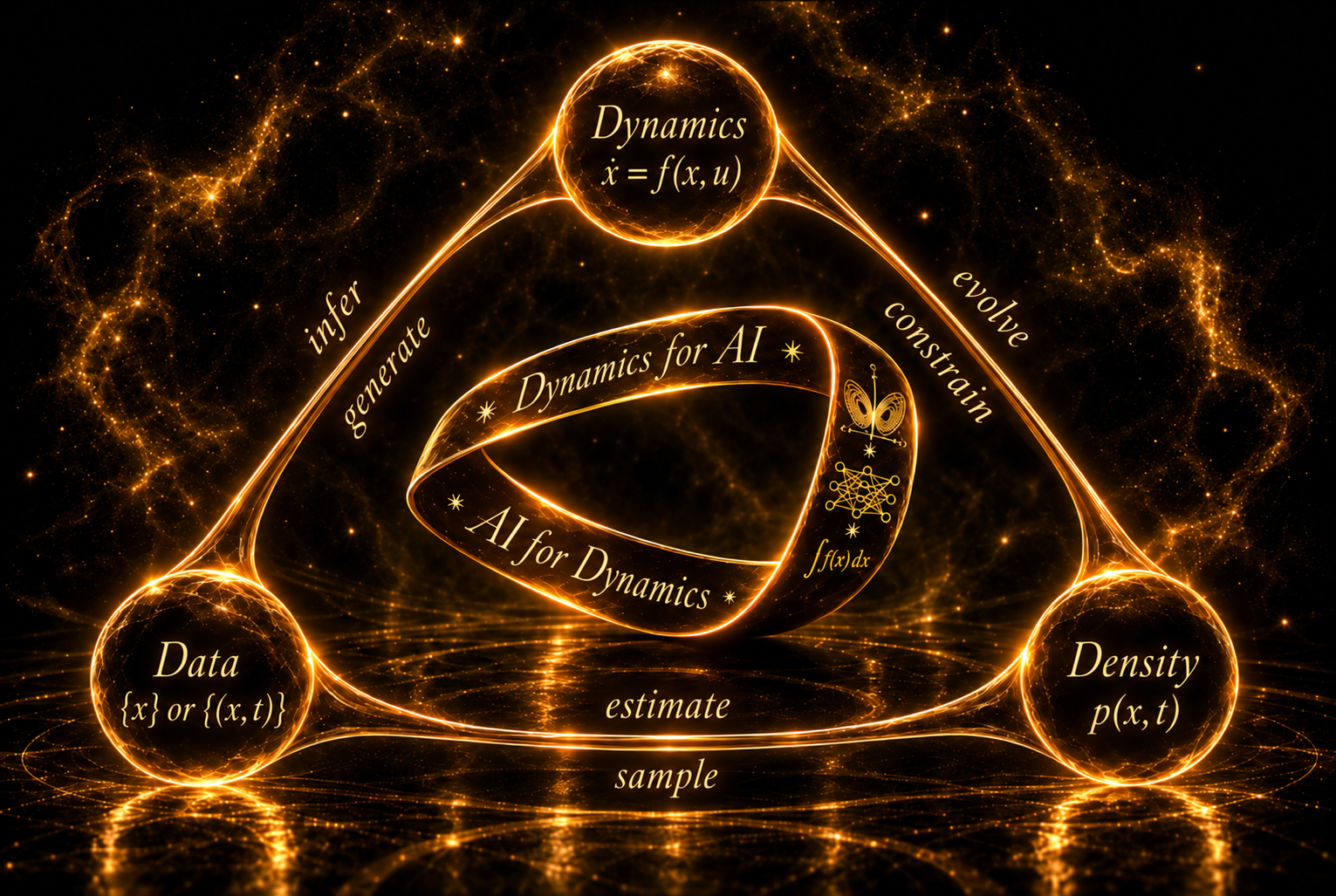
Data, density, and dynamics form a triangle around a Möbius strip connecting Dynamics for AI and AI for Dynamics. View the research map
Two directions. One research program.

The research program

Intelligence through dynamics.
Dynamics through intelligence.

I study how evolving states represent, retain, and transform information, and how observations reveal the systems that produce them.

01 Build

Dynamics for AI

How do the geometry and evolution of computational states determine what a system can remember, infer, and generate? I connect dynamical theory with the capabilities of recurrent networks, attention, and adaptive systems.

Principles of intelligent computation
02 Discover

AI for dynamics

What can observations reveal about the processes that produced them? I develop methods to infer hidden states and dynamical laws from partial measurements and population snapshots, including what the data leave undetermined.

From observations to dynamical laws

About

Zhixin Lu

Scientist at the Allen Institute
Seattle, Washington

Background & CV

My work brings together nonlinear dynamics, stochastic processes, machine learning, and neuroscience. I earned my Ph.D. with Edward Ott at the University of Maryland and was a postdoctoral researcher with Danielle Bassett at the University of Pennsylvania.

My research has explored prediction of spatiotemporal chaos, reservoir observers for hidden-state inference, learned attractors, and source separation using simulated water dynamics. These studies motivate a broader ambition: to understand the dynamical principles that make intelligent computation possible.

Ideas & explanations

From the research notebook

All writing

Proof intuition, dynamical principles, and interactive explanations.

New · DyNoSeD & BPPB seminar

Discovering dynamics from snapshots

How a stationary cloud constrains stochastic dynamics, why different laws can produce the same snapshots, and what the data actually identify. With an interactive example.

Two directions, one research program

Data, density, and dynamics connected around the Möbius strip of Dynamics for AI and AI for Dynamics.

Data, density, and dynamics organize the questions a learning system can address. The connections are intentionally undirected: the route depends on the observations and the task.