Research

Building intelligent
dynamical systems.

Biological and artificial intelligence operate through evolving internal states. I study how those states support computation and learning, and how AI can reveal the dynamics of the world.

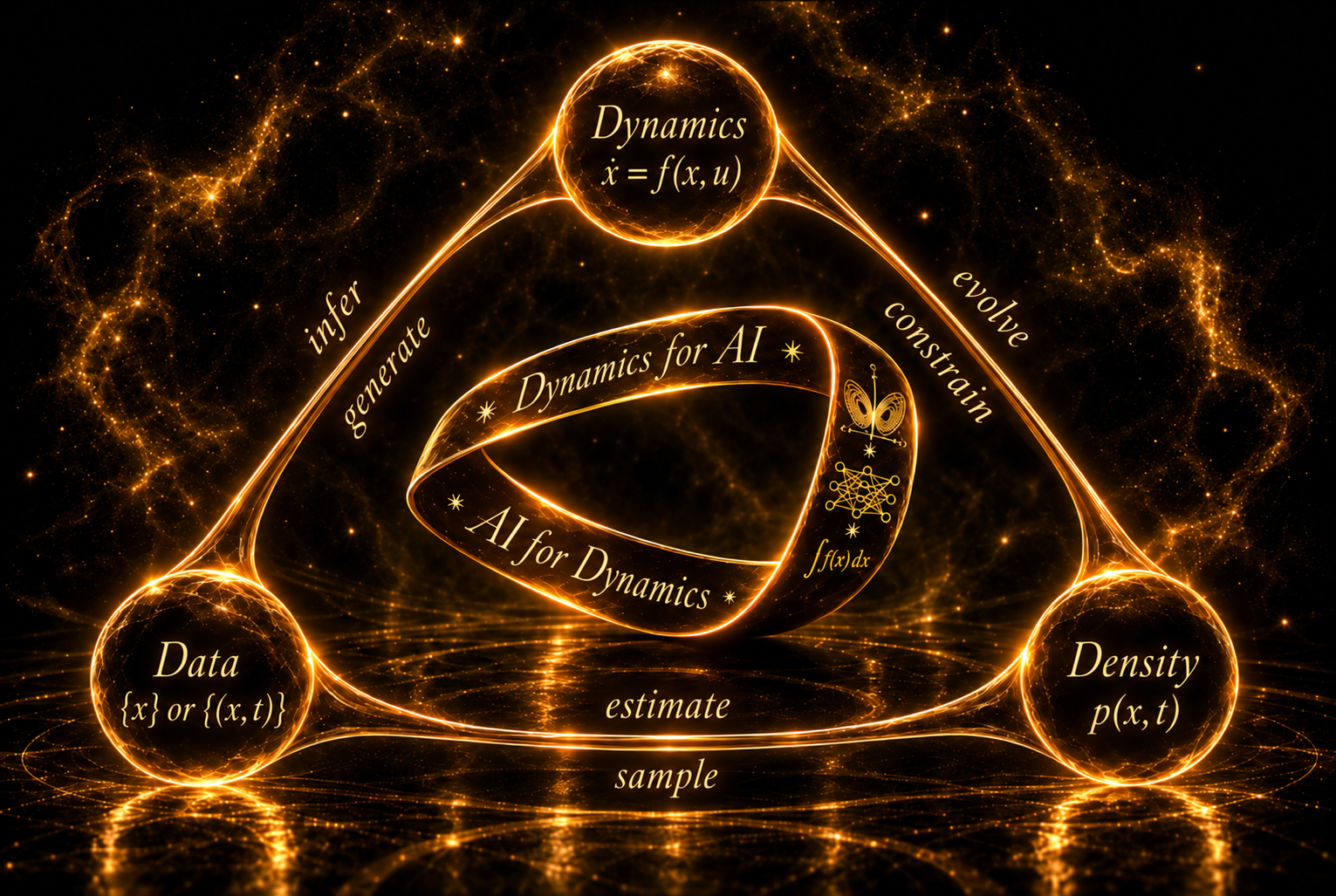
Data, density, and dynamics form a triangle around a Möbius strip linking Dynamics for AI and AI for Dynamics.
Research program · View full size ↗

A common map

Two directions,
one program.

Dynamics for AI uses dynamical principles to understand and build intelligent systems. AI for dynamics develops methods to infer hidden states and dynamical laws.

Data, density, and dynamics connect these directions. Different observations support different tasks, from recovering missing variables to learning laws and generating temporal patterns.

The figure is a conceptual map. Its connections are intentionally undirected; the available information and the question determine the route.

01 Dynamics for AI

Principles for intelligent computation

How do the geometry and evolution of computational states determine what a system can remember, infer, generate, and learn?

Representation, memory & adaptation

I study recurrent networks, attention, and adaptive systems as evolving computational states. My goal is to connect their capacity, geometry, and stability with the computations they can perform, and to use those principles to guide architecture design.

A geometric view of attention →

Synchronization & learned dynamics

Under suitable conditions, a driven network can form an invertible representation of another system’s state. My work on attractor reconstruction and generalized synchronization connects this mechanism to inference and generation, with stability essential when a model runs on its own.

How recurrent models learn dynamics →
New preprint

Limits of stable generation

Can a system stably generate a learned dynamical pattern backward in time? My recent theorem identifies an obstruction for a class of chaotic dynamics, including the classical Lorenz attractor. It applies to exact realization by finite-dimensional C2 autonomous systems with compact attracting sets and continuous readouts.

An Arrow of Time in Stable Autonomous Generation ↗
The intuition behind the proof →

02 AI for dynamics

From observations to states and laws

What dynamical structure can incomplete observations reveal, and what remains ambiguous?

Hidden states & source separation

Reservoir observers infer unmeasured variables from partial observations. Related work uses synchronized representations to separate mixed sources and identify dynamics. I study when temporal structure makes these tasks possible.

Reservoir observers ↗

Dynamical laws from snapshots

Measurements often sample a population without tracking its individuals. My DyNoSeD framework uses Fokker–Planck constraints to infer stochastic dynamics from stationary, non-sequential samples and assess which parameters the observations constrain within a specified model.

DyNoSeD in Chaos ↗
The intuition & an interactive example →

Biological dynamics

Neuroscience provides a demanding setting for these questions, from single-neuron models to the relationship between cell types and physiology. I connect mathematical descriptions with what biological measurements can establish.

Recent neuroscience studies →

A central research interest

Physical AI
& learning

How does the physics of a system shape its capacity to compute, adapt, and learn?

I am interested in the foundations of intelligent computation and learning in physical systems: how dynamics, stability, and the constraints of a physical medium shape capability, robustness, and energy efficiency.

My published source-separation study used simulated water dynamics as a computational substrate. A trained readout recovered chaotic sources from the simulated response to their mixture. This work motivates broader questions at the intersection of physics and intelligent computation.

Supervised chaotic source separation by a tank of water ↗